It’s 6:15am on a July morning in Cherrybrook, and the rain hasn’t let up since midnight. You’re standing in the kitchen with a coffee, half-listening to the news, when you hear it — that unmistakable drip… drip… drip coming from somewhere near the hallway ceiling. By the time you grab a bucket, there’s already a water stain spreading across the paint like a bruise.
This is how most Sydney homeowners find out their roof needed attention weeks ago.
Winter in the Hills District doesn’t bring snow or freezing temperatures, but it brings something arguably more relentless for your roof: sustained heavy rain, sharp temperature swings, and the kind of storms that turn small, ignored problems into five-figure repair bills. The good news is that almost all of it is preventable if you know what to look for before the worst of the season hits.
The Real Winter Threat: Storm Damage and Gutter Overflow
Forget ice — the risk that actually matters here is water with nowhere to go. When Sydney gets one of its intense winter downpours (and the Hills District is no stranger to them), your gutters and downpipes are doing all the work of keeping that water away from your roofline, fascia, and foundations. If they’re even partially blocked, water backs up, pools under roof tiles or sheeting, and finds its way inside through the smallest gap in flashing or sarking.
This is the winter equivalent of ice damming for a climate like ours: not ice, but overwhelmed drainage. The mechanism is different, but the result is the same — water pushed backward under your roofing material because it can’t flow where it’s supposed to.
What it looks like when it’s already a problem:
- Water stains or bubbling paint on ceilings, especially near external walls
- Gutters visibly overflowing during rain, sheeting down the side of the house
- Sagging gutter sections, or gutters pulling away from the fascia
- Damp smell in the roof cavity or top-floor rooms after storms
If you’re seeing any of these, don’t wait for the next big system to roll through — Sydney’s winter storm season tends to compress into a handful of intense events rather than spreading evenly, so there often isn’t much warning between “manageable” and “urgent.”
Moss and Lichen: Slow-Motion Roof Damage
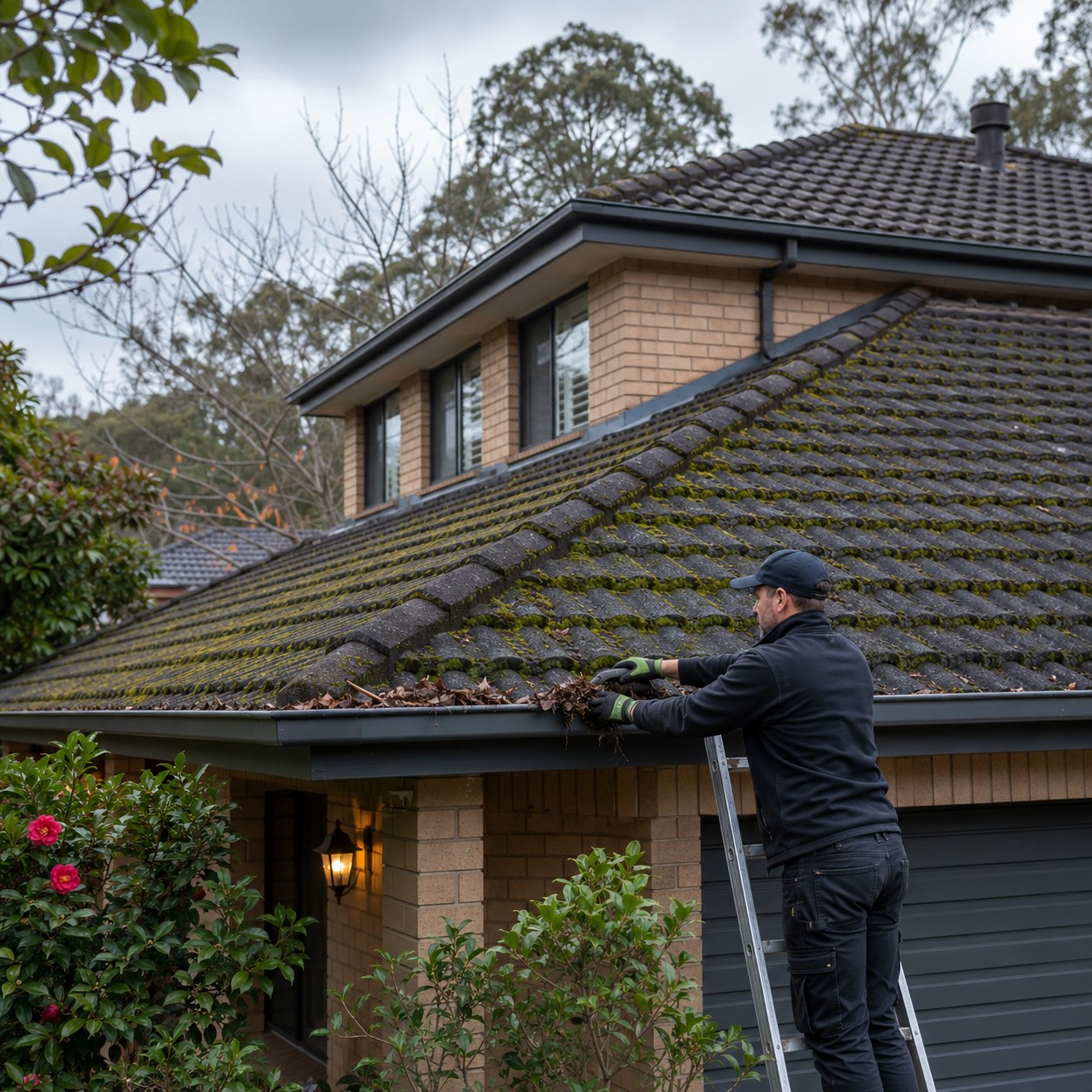
Cherrybrook’s leafy, tree-lined streets are lovely to live on and terrible for your roof’s drainage. Shaded, south-facing sections of roof that don’t get much direct sun stay damp for days after rain, which is exactly the environment moss and lichen need to establish themselves on tiles.
It looks harmless at first — a bit of green fuzz, maybe some dark staining. But moss holds moisture directly against the tile surface, and over time that trapped moisture:
- Breaks down tile coatings and accelerates cracking, especially through freeze-thaw-style expansion during cold nights
- Lifts tiles slightly at the edges, creating entry points for wind-driven rain
- Adds significant weight to your roof when saturated, which matters on older structures
- Clogs valleys and gutters as it breaks apart and washes down
Left unchecked over a few winters, moss can shave years off a tile roof’s lifespan. It’s one of the cheapest problems to fix early and one of the most expensive to fix late.
DIY Tips You Can Actually Do This Weekend
Before you call anyone, there’s a decent amount you can handle yourself — as long as you’re realistic about your comfort with heights and ladders.
1. Clear your gutters properly, not just the visible bits. Grab a trowel or gutter scoop and physically remove leaf litter, twigs, and sludge — don’t just hose it and hope. Flush with water afterward to confirm downpipes are actually flowing, not just that the gutter looks empty.
2. Check your downpipes at ground level. A blocked downpipe upstream causes the exact same overflow as a blocked gutter, and it’s much easier to check from the ground. Look for water pooling near the base during rain — that’s your sign.
3. Treat visible moss with a proper roof-safe treatment. Avoid high-pressure washing tiles — it strips the protective coating and can force water under tiles rather than off them. A soft-wash treatment or a diluted zinc/copper sulphate solution applied and left to work (rather than scrubbed) is safer for most tile types.
4. Trim back overhanging branches. Less shade means faster drying, which means less moss regrowth. It also means fewer leaves in your gutters come autumn.
5. Do a visual check from the ground with binoculars. Look for cracked, slipped, or missing tiles, and any obvious lifting at the ridge line or valleys. You don’t need to get on the roof to spot most red flags.
When It’s Time to Call a Professional
DIY has real limits here, and knowing where they are will save you money and, honestly, keep you off a wet tile roof in July.
Call a professional if:
- You’ve cleared gutters but still see overflow or pooling during rain
- There’s any sign of water inside the house — even a small stain
- Moss coverage is heavy, or has been present for more than one season
- You’re not confident getting on the roof safely (wet tiles in winter are genuinely dangerous)
- Your roof is older, or you’ve never had a proper inspection done
A proper pre-winter roof inspection typically costs far less than the water damage repair, mould remediation, and re-tiling that come from problems left to run through a full storm season. Most reputable Cherrybrook roofers will also flag issues you can’t see from the ground — cracked flashing around vents, deteriorating sarking, or valley irons starting to corrode.
The Bottom Line
Sydney winters won’t freeze your gutters solid, but they will absolutely find every weak point in your roof’s drainage system over the course of a few solid storms. Clear the gutters, deal with the moss, keep an eye on the ceiling after heavy rain, and bring in a professional the moment something looks off rather than after it’s already inside the house. A couple of hours of prep now is a lot cheaper than a ceiling repair in August.